
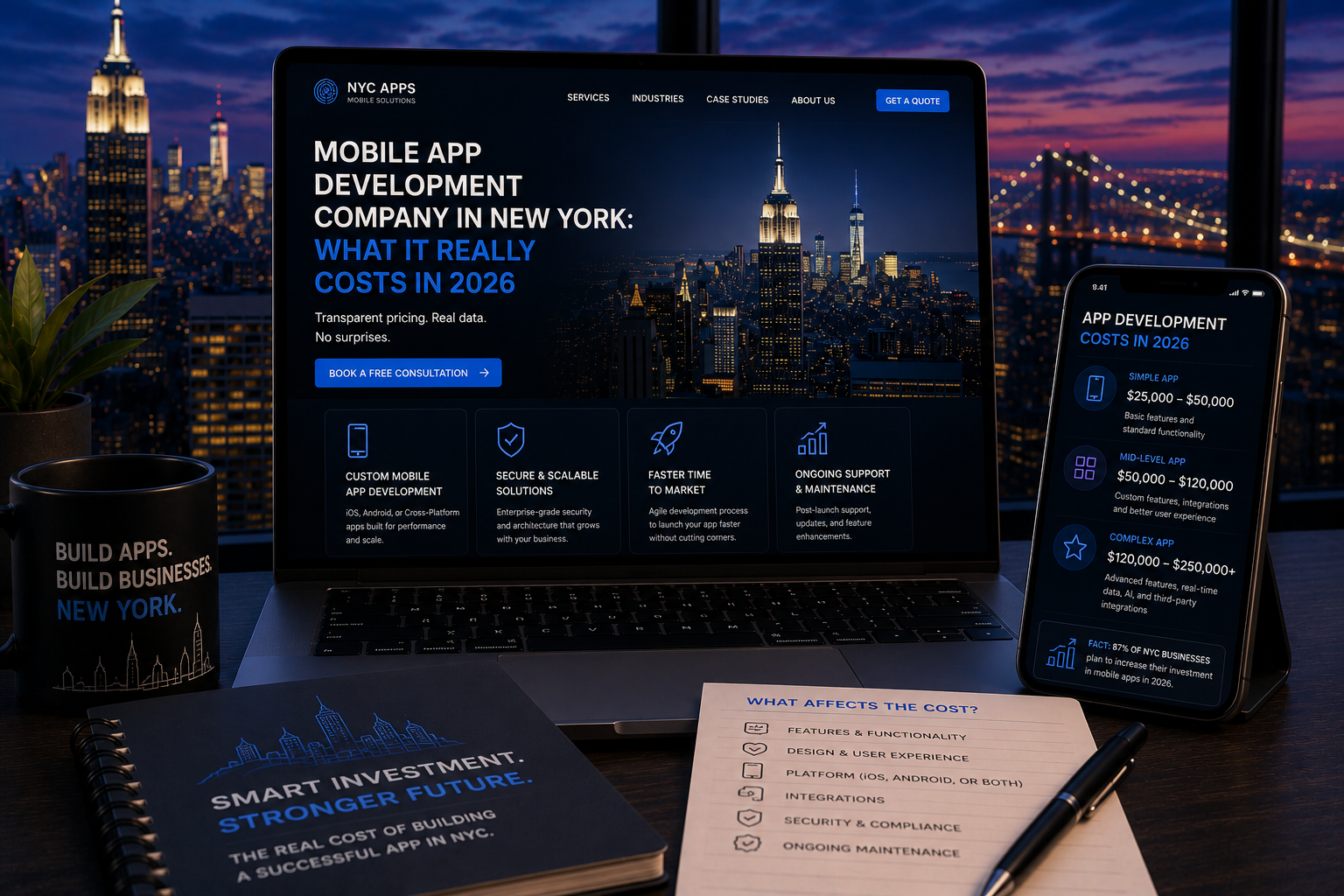
"How much does it actually cost to build an app in New York?"
Almost every business owner and founder asks this question in the first five minutes of a discovery call, and rarely gets a straight answer. The truth is, there isn't one number. But there is a real range, and real factors that move you up or down within it. Let's break it down properly.
The Real Numbers (Not the Marketing Version)
Based on current 2026 market data from multiple New York development firms, here's roughly where projects land:
- Simple apps (basic UI, login, limited functionality): $20,000 – $50,000
- Mid-complexity apps (payments, push notifications, live chat, API integrations): $50,000 – $150,000
- Complex or enterprise apps (AI features, real-time data, high scalability): $150,000 – $300,000+
New York developer rates run high compared to national averages. Senior mobile engineers in the city typically bill $150–$250 per hour, with full-stack developers around $120–$180 per hour, according to recent NYC development-market pricing data. That's not a random markup; it reflects the cost of living, the depth of the talent pool, and demand from the city's booming tech and fintech sectors.
Don't forget maintenance. Most mobile app development company in New York recommend budgeting 15–20% of your original build cost annually for updates, bug fixes, and platform compatibility as iOS and Android roll out new versions.
Why New York Is Different From Everywhere Else
New York isn't just an expensive place to build software; it's also one of the most active. The city is home to over 2,000 AI startups alone, and NYC-based companies have raised more than $27 billion in AI-related funding since 2019, according to Tech: NYC's ecosystem data. Fintech is even bigger: NYC fintech startups captured roughly 30% of all U.S. fintech investment in 2024.
What does that mean for you? It means the developer talent pool in New York is used to building complex, regulated, high-stakes applications, banking apps, healthcare platforms, and real-time trading tools. That expertise is priced accordingly, but it also means you're not settling for a team that's only ever built simple to-do apps.
The broader U.S. mobile app market backs this up too; it's valued at roughly $206 billion in 2025 and is projected to grow to nearly $285 billion by 2029, according to Statista's market projections. Businesses that get into the app space now are entering a market still very much in growth mode.
What Actually Drives Your Cost Up or Down
Platform choice: Building for iOS only or Android only costs less than building for both. Cross-platform frameworks can reduce cost but sometimes trade off performance for complex apps.
Features, not screens: A five-screen app with real-time chat and payment processing costs more than a fifteen-screen app that's mostly static content. Functionality drives engineering hours, not visual complexity.
Design expectations: Custom UI/UX with original illustrations and animations costs more than using established design patterns, and for most early apps, that's fine. Users care more about the app working smoothly than about custom micro-animations.
Integrations: Every third-party service you connect- payment processors, mapping APIs, CRM systems- adds development and testing time.
Compliance needs: If you're building in fintech or healthcare, expect costs on the higher end due to security, encryption, and regulatory requirements like PCI-DSS or HIPAA.
How to Avoid Overpaying (Without Underbuilding)
The smartest approach most founders and business owners use is starting with an MVP, a minimum viable product that includes only the core features needed to test the idea with real users. This typically keeps initial costs closer to the $20,000–$50,000 range rather than jumping straight into a $150,000+ full build.
The Hidden Costs Nobody Mentions Upfront
- App store fees: Apple and Google both take a cut of in-app purchases
- Cloud hosting and backend infrastructure: Ongoing, not one-time
- App store optimization: Getting found in the App Store or Play Store isn't automatic
- Marketing and user acquisition: The app working doesn't mean people know it exists
Budget for these from day one, or your "final" cost will keep climbing after launch.
FAQs
Why do New York developers charge more than offshore teams?
Cost of living, demand, and the concentration of specialized talent in fintech, healthcare, and AI all push NYC rates higher. Offshore teams can offer lower hourly rates, but often come with communication overhead, time zone gaps, and less accountability, factors worth weighing beyond the sticker price.
How long does it take to build a mobile app in NYC?
Most projects take 2 to 6 months depending on complexity. Simple MVPs can launch faster; complex, feature-rich apps or those requiring compliance review can take longer.
Is it cheaper to build for one platform first?
Yes. Building for iOS or Android first, then expanding to the other platform once you've validated demand, is a common way to control initial costs without limiting future growth.
What's included in the 15–20% annual maintenance cost?
This typically covers OS compatibility updates, bug fixes, security patches, and minor feature adjustments. It does not usually include major new feature development, which is quoted separately.
Can I get a fixed price instead of an hourly estimate?
Many agencies offer fixed-price quotes once your scope is clearly defined. Be cautious of fixed quotes given before a proper discovery process; they often come with vague exclusions that surface later as change orders.
Bottom Line
There's no universal price tag for a mobile app in New York, but there is a realistic range, and understanding what actually drives cost puts you in a much stronger negotiating position. Start with a clear scope, ask for a tiered quote, and work with a mobile app development company in New York teams have actually shipped products, not just pitched them.